Ketoclin
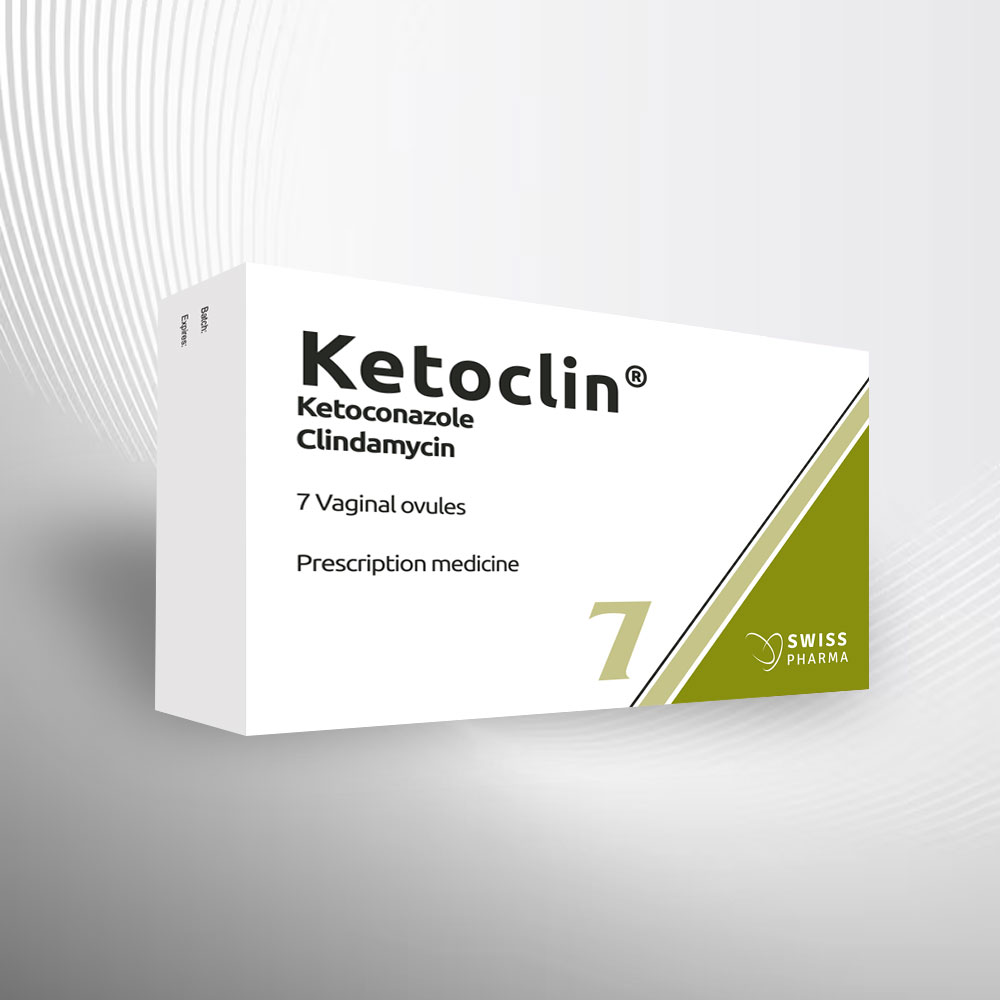
Instructions for use of the drug (for patients)
KETOCLINEvaginal suppositories
KETOCLIN®
International non-proprietary name:Clindamycin + Ketoconazole
Composition
Active ingredients: 1 suppository contains 100 mg of clindamycin (in the form of clindamycin phosphate),
Contains 400 mg of ketoconazole.
Auxiliary substances: mineral oil, white vaseline, soy lecithin, skin gelatin (150 Bloom)
glycerin, yellow dye (FDC No. 6), red dye (FDC No.
40), titanium dioxide, migliol.
Description
They are pink-orange (salmon) colored, cone-shaped, soft gelatin candles with a convex surface.
Pharmacotherapeutic group
Means with broad-spectrum antibacterial, antifungal effect.
ATC code:Clindamycin: G01AA10.
Ketoconazole: G01AF11.
Pharmacological properties
Clindamycin- is an antibacterial substance from the group of lincosamides, with a wide spectrum of action. Clindamycin has an inhibitory effect on protein synthesis in bacteria by affecting the ribosome of bacteria. It mainly binds to the 50S subunit of the ribosomal membrane, inhibits protein synthesis and affects the process of building a peptide chain. Clindamycin has a wide spectrum of action, has a bacteriostatic effect in therapeutic doses, and has a bactericidal effect on microorganisms in high doses. Clindamycin is active mostly against gram-positive aerobic, as well as gram-positive and gram-negative anaerobic bacteria.Gardnerella vaginalis, Mobiluncus spp. active against microorganisms associated with bacterial vaginosis, including (in vitro):Mobiluncus mulieris, Mobiluncus curtisii, Mycoplasma hominisandPeptostreptococcus spp., Bacteroides spp. Gardnerella vaginalis.
Ketoconazole- is an imidazoledioxolane derivative, has antifungal, fungicidal, anti-inflammatory, fungistatic, antiandrogen properties, has a targeted effect on the pathological center. The use of vaginal tablets allows to destroy the pathogenic flora that causes burning and itching of the vagina in the shortest possible time, and to get rid of unpleasant symptoms. The mechanism of action is based on inhibiting the synthesis of ergosterol and changing the lipid content of the mushroom membrane (Candida, Trichophyton, Epidermophyton, Entomophthorales, Pityrosporum, Torulopsis, Cryptococcus, Malassezia furfur).Candida albicansIt mainly has a fungicidal effect against 'a.
Even to gram-positive cocci:Staphylococcus spp., Streptococcus spp. is active against
Pharmacokinetics
Clindamycin has a low rate of absorption during vaginal use; the concentration in the blood is about 2-8%. When applied to the skin, absorption is very low (0-3 ng/ml). Clindamycin administered vaginally is not metabolized by auto-depuration and is eliminated from the body through normal excretions.
Absorption of ketoconazole into the blood during vaginal use is minimal. The maximum concentration in plasma can be 20.7 ng/ml. Ketoconazole, when used vaginally, does not undergo biotransformation and is eliminated through the mechanism of vaginal autodeflection.
Instructions for use
Gardnerella vaginalis,Mobiluncus sppbacterial vaginosis caused by
Bacteroides fragilisvaginosis and vaginal candidiasis caused by other anaerobic bacteria.
Contraindications
Hypersensitivity to any component contained in the preparation. It is contraindicated in patients suffering from Crohn's disease, ulcerative colitis, as well as colitis caused by the use of antibacterial drugs.
Special instructions and precautions
Clindamycin
Pseudomembranous colitis has been observed with the use of almost all antibacterial agents, including clindamycin, and its severity can range from mild to severe with oral or parenteral use. Diarrhea, bloody diarrhea, and colitis (including pseudomembranous colitis) have been reported with the use of oral and parenteral clindamycin, as well as topical (cutaneous) forms of clindamycin. Therefore, it is important to consider the diagnosis of pseudomembranous colitis in patients presenting with diarrhea after taking clindamycin, even when administered vaginally, approximately 5% of the dose of clindamycin is systemically absorbed from the uterus. After the diagnosis of pseudomembranous colitis, treatment measures should be started. Mild cases of pseudomembranous colitis usually lead to drug discontinuation alone. In moderate and severe cases, fluid and electrolyte intake, protein supplementation andClostridium difficiletreatment with a clinically effective antibacterial agent should be considered for colitis caused by Symptoms of pseudomembranous colitis may occur during or after antimicrobial therapy.
Ketoconazole
Ketoconazole taken orally has a clinically significant potential for interaction with other drugs because it can interact with the P450 enzyme system of the liver and inhibit their metabolism, these changes are not observed with local vaginal use due to almost zero absorption.
Precautions
Use of clindamycin phosphate may result in the development of nonsusceptible organisms, particularly candidiasis. You should not have sex during treatment with this drug. The product may cause vaginal irritation, itching and stinging.
Interactions with other drugs
Enhances the effect of aminoglycosides and rifampicin. Strengthens the muscle relaxant effect of N-cholinoblockers.
Use during pregnancy and lactation
It is not recommended to use in the 1st trimester of pregnancy, but it can be used in other trimesters under the supervision of a doctor if the expected benefit outweighs the potential risk.
It is not used during lactation.
Ketoconazole and Clindamycinin vitroDuring the studies, it was found that the drug has no mutagenic effect.
Effects on the ability to drive a vehicle and other potentially dangerous mechanisms
Effects on the ability to drive vehicles have not been observed.
Method of use and dosage
1 vaginal suppository is used daily for 7 consecutive days before going to bed or is prescribed based on the doctor's decision and clinical assessment.
Special groups
There is no experience with the use of this drug in patients over 65 years of age, people with kidney failure and girls under 16 years of age.
Instructions for use
Wash your hands before and after using this medicine.
Acceptance
Remove the candle from its packaging. Lie on your back with your knees pulled towards your chest. With the tip of your middle finger, insert the candle as deeply as possible into the vagina without causing discomfort.
In case of forgetting
If you are only a few hours late, use the medicine immediately.
Side effects
In patients with a sensitive body, the drug can cause dryness of the vaginal mucus, irritation and itching in the external genitalia. These cases also pass when the use of the drug is stopped.
Often: headache, abdominal pain, diarrhea, nausea, vaginal discomfort, burning sensation in the vagina.
Rarely: vomiting, rash, upper stomach pain, fever or chills, painful urination, blood in the urine, foul-smelling urine, urgency to urinate, vaginal infection, vaginal discharge, irregular menstruation, pain (at the site of application), local swelling.
Frequency not known: itching.
Overdose
No cases of overdose have been reported. In case of overdose, general symptomatic and supportive measures should be taken.
Release form
7 candles in a blister. 1 blister is packed in a cardboard box with a leaflet.
Storage conditions
It should be stored at a temperature of 25°C, in a dry, cool place and out of the reach of children.
Shelf life
2 years.
It is prohibited to use after the expiration date.
Condition of release from pharmacies
It is released on the basis of a prescription.
Manufacturer
Swiss Pharma Group S.A., Paraguay.
Zapadores del Chaco corner Abraham Lincoln and Lopez de Vega-San Lorenzo, Paraguay.
Holder of registration card
LLC, Republic of Azerbaijan.
Khirdalan city, 12th km of Baku-Guba highway, Building 2 No. 3, Republic of Azerbaijan