Foraktin
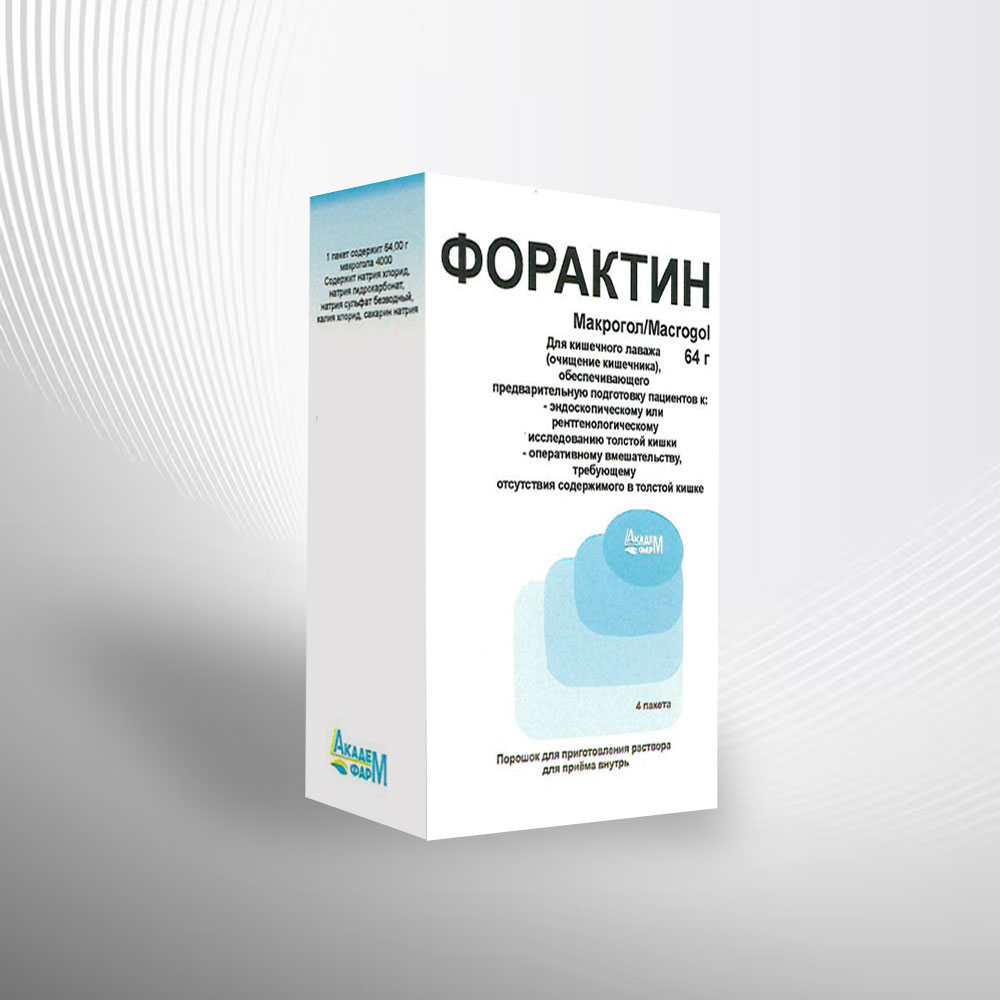
Instructions for use of the drug (for patients)
FORAKTIN powder for oral solution
FORACTIN®
International non-proprietary name:Macrogol
Composition
The active substance: 1 package contains 64.0 g of macrogol 4000.
Auxiliary substances: potassium chloride, sodium chloride, anhydrous sodium sulfate,
sodium bicarbonate, sodium saccharin.
Description
It is a white powder. The prepared solution is a clear liquid, colorless and odorless.
Pharmacotherapeutic group
Anti-constipation drugs. Osmotic softeners. Macrogol.
ATC code:A06AD65.
Pharmacological properties
Pharmacodynamics
The preparation is an osmotic anti-constipation agent containing Macrogol 4000 and electrolytes (sodium, potassium, bicarbonate and chlorides).
High molecular weight Macrogol 4000 is a long linear polymer capable of retaining water molecules through hydrogen bonds. After oral administration, the drug increases the volume of liquid in the intestine. The volume of unabsorbed liquid in the intestine ensures the anti-constipation effect of the medicinal solution. Electrolytes contained in the preparation protect the effect of blood plasma.
Pharmacokinetics
Due to its high molecular weight, macrogol 4000 is not absorbed or metabolized in the gastrointestinal tract after oral administration. It is excreted unchanged through the intestine.
The composition of electrolytes in the solution is balanced in such a way that the exchange of electrolytes between the intestine and plasma can be considered practically zero.
Instructions for use
- Preparation of the large intestine for endoscopic or X-ray examination
- Preparation of the colon for surgical intervention
Contraindications
- Sensitivity to any component of the preparation
- Dehydration or severe heart failure
- Cancer (carcinoma) or other intestinal disease accompanied by severe mucosal damage
- Intestinal obstruction
- Perforation or risk of perforation of the digestive system
- Impaired gastric emptying (eg, gastroparesis)
- Toxic colitis or toxic megacolon
- Children under 18 years of age
Special instructions and precautions
Diarrhea caused by taking the drug can significantly disrupt the absorption process of drugs taken at the same time. In the first hours of taking the drug, nausea, vomiting and foam in the stomach may be observed, but these usually pass during continuous use. In very rare cases, an allergic reaction (anaphylactic shock, rash, angioedema) may be observed due to polyethylene glycol (macrogol) contained in the drug. It is not recommended to prescribe this medicine to people who are hypersensitive to polyethylene glycol.
Due to the isotonic composition of the drug, electrolyte disturbances are not expected, but patients should be warned about such risks. This drug should be used with caution in patients with impaired kidney function, heart failure, or those taking diuretic (diuretic) drugs, i.e., those prone to water-electrolyte imbalance. In such cases, medical supervision is important.
In patients at risk of aspiration (food or liquid falling into the respiratory tract) - for example, bedridden patients, those with neurological or movement disorders - the drug should be used only with medical supervision and caution due to the risk of aspiration pneumonia. At this time, the drug should be given in a sitting position or by a nasal probe (with a tube through the nose). Patients with heart and kidney failure are at risk of acute pulmonary edema (swelling) due to sodium overload.
One package of the preparation contains 1,967 grams of sodium – this should be considered for patients on a diet that limits salt intake.
Ischemic colitis
Information on the development of ischemic colitis, including severe cases, has been obtained during the use of macrogol-containing drugs in preparation for the examination of the intestine.
Macrogol should be prescribed with caution in patients with risk factors for the development of ischemic colitis or in combination with laxatives with a stimulating effect (for example, bisacodyl or sodium picosulfate). Patients with sudden onset abdominal pain, rectal bleeding, or other symptoms consistent with ischemic colitis should receive immediate medical evaluation.
Interaction with other drugs
Before prescribing the drug, the doctor should inquire about all the oral (oral) medications the patient is taking. Diarrhea caused by the use of the drug can interfere with the absorption of other drugs taken orally at the same time. For this reason, the drug should be taken at least 2 hours after taking other drugs. It is recommended to refrain from taking other medications until the examination process with a colon cleanser is complete. In particular, the effect of drugs with a narrow therapeutic range and a short half-life can be significantly reduced.
Use during pregnancy and lactation
Fertility
Animal studies are insufficient to assess the reproductive toxicity of the drug.
Pregnancy
Data on the use of macrogol in pregnant women are limited. The drug should be used only during pregnancy if the benefit outweighs the possible risk.
Lactation
Information on the use of the drug during lactation is limited. It is not known whether Macrogol 4000 passes into breast milk.
Risk in newborns or infants cannot be completely excluded. For this reason, the drug should be taken during lactation only when the benefit of using the drug is higher than the possible risk.
Effects on the ability to drive vehicles and other potentially dangerous mechanisms
No studies have been conducted to study the effect of the drug on driving a car or working with other mechanisms.
Method of use and dosage
The drug is prescribed only to adults internally, perorally (by mouth).
The solution should be prepared immediately before use. The contents of one package of the drug are gradually added to 1 liter of water and mixed evenly.
Recommended dosage:
The solution is taken in separate sips, one glass every 15 minutes - 1 liter of solution should be drunk within 1 hour.
The dose is calculated according to the patient's body weight - 1 liter of solution per 15-20 kg of weight (approximately 3-4 liters of total volume).
Dosage regimen
The drug can be taken according to two different schemes:
One-stage preparation: 3-4 liters of solution is taken in the evening, the day before the examination or operation (if the procedure is planned in the morning).
Two-stage preparation: 2-3 liters of solution is taken in the evening, and the rest in the morning. Reception can be completed 3-4 hours before the procedure.
The treating doctor can recommend the drug's administration scheme based on the patient's clinical condition and the risk of possible complications. Patients are advised not to eat solid food 2-3 hours before taking the drug and until the examination is completed.
Patients with renal failure:
Information on the use of the drug for this patient group is limited.
Children:
The safety and effectiveness of the drug in children under 18 years of age have not been studied.
Side effects
At the beginning of taking the drug, cases of nausea and vomiting were observed, which usually passed as the intake continued.
Information on adverse effects is presented according to system organ classes and frequency of occurrence. Frequency categories: very common (≥1/10), common (≥1/100 but